5 Skills Every Teen Needs
That Nobody Is Teaching Them
They get tested on all five of them, every week, in every class, yet have been taught none of them. Here is what they are, why none of this is laziness, and what you can actually do at home about each one.
“Have you done your homework?”
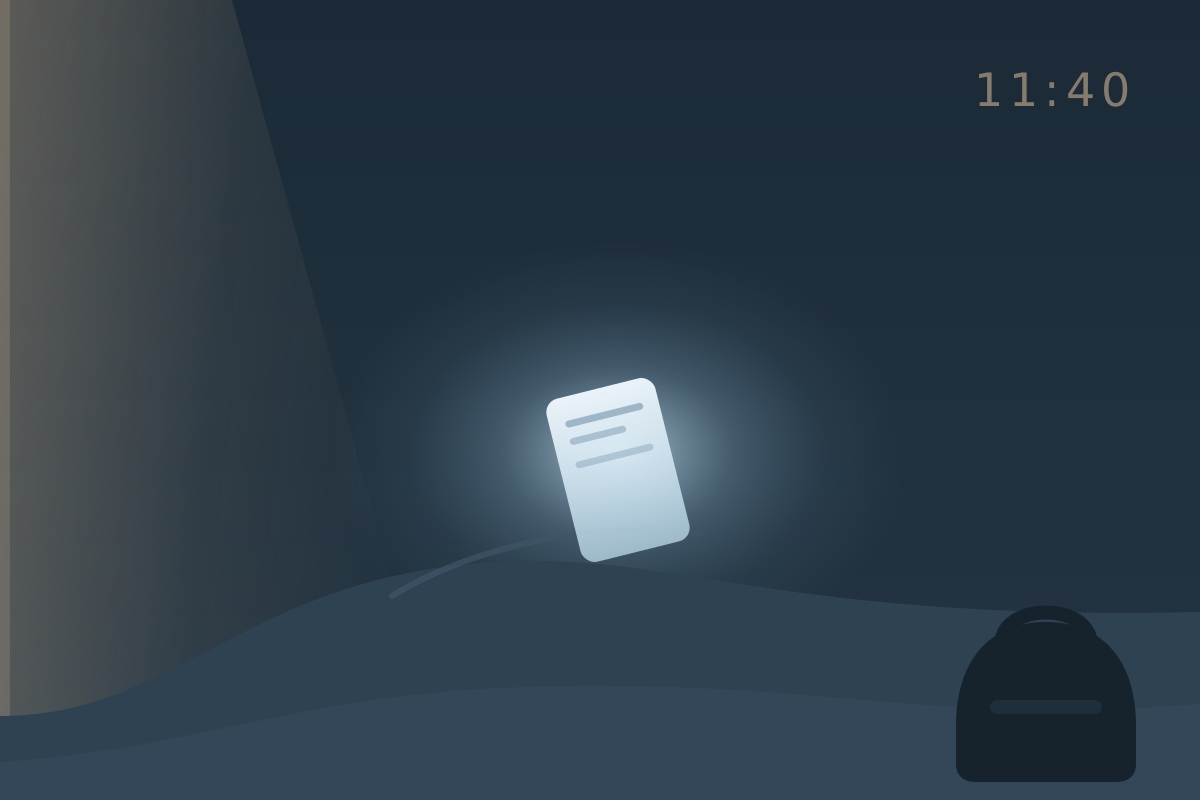
Your voice cut through the darkness and echoed in the blanket draped over his head, as he stared mindlessly at the only source of light in the room.
“I’ll do it in a second.”
He won’t. You know he won’t. So you cross the room with fury on your face, rip the blanket off, and tear the phone out of his hand.
“That’s it. I’m done! You need to stop being so lazy!”
Then the shouting battle began.
Later that night, your anger melts into guilt. Is this my fault? Am I going crazy? Why is he like this? I wish I knew how to help him. He gets good grades, but if I stop holding him accountable I think the whole thing falls apart. The thoughts spun around the rest of the night.
And this’ll happen again in a few months.
He Isn’t Lazy
He’s missing five specific skills — sleep, activation energy, deliberate practice, self efficacy, and treating failure as data — and he’s in a system that tests him on all of them and teaches him none of them. Every one of the five is learnable. None of them is taught by accident.
I say that as a former teacher who tried to teach executive functioning. But the system wasn’t built for it. I made every kid put their phone in a holder at the front of my room, and I put mine in there too. Then they walked out and into the next block, where Mr. Clean was watching the basketball game on his phone instead of teaching.
But it is still a choice schools make. Schools in Japan have students clean their own classrooms and serve each other lunch. Those are teachable skills. Somebody just has to teach them.
So rather than sending your kid to Japan, here are five practical skills you can help form in them.
1. Sleep
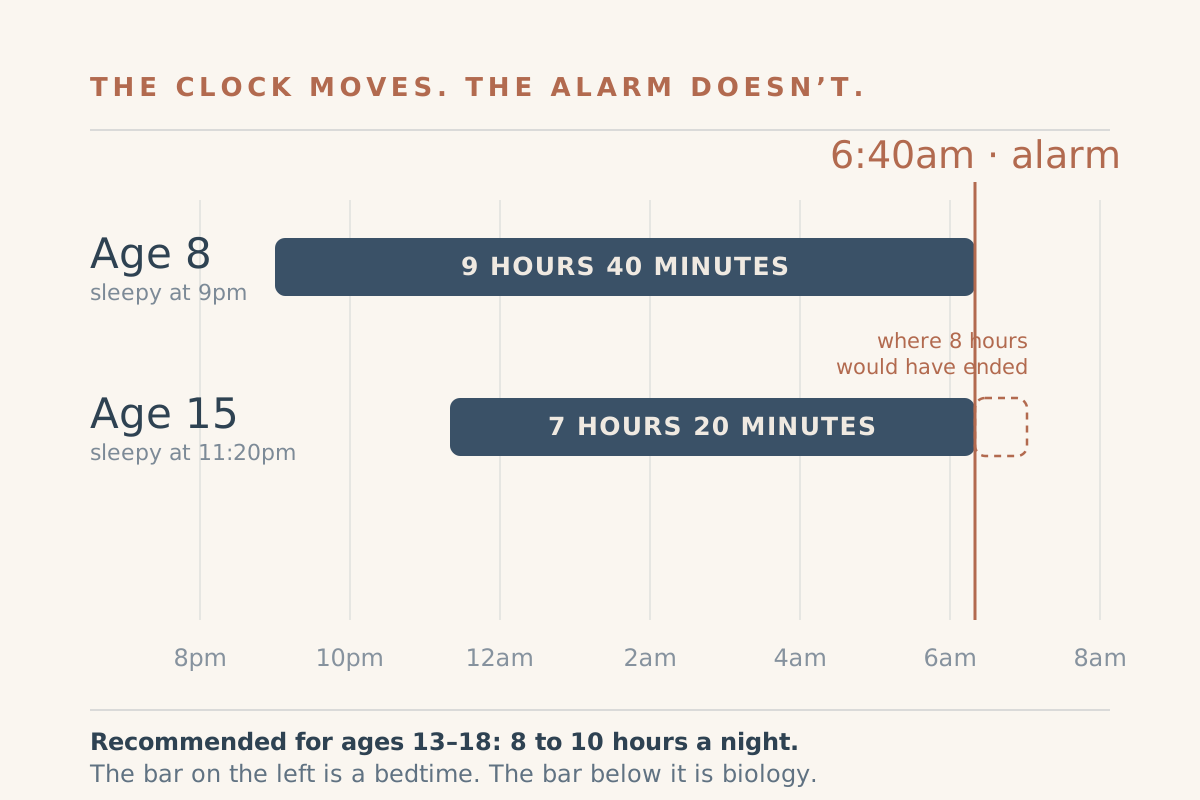
It’s 11:40pm and you can see the light under his door. He swears he isn’t tired, and he’s telling the truth. At 6:40am an earthquake wouldn’t wake him. Saturday he sleeps until noon and you let him because he clearly needs it. Monday, the same thing again.
“Just go to bed earlier.”
“This is not simply a matter of teenagers making better choices at bedtime,” says Dr. Indira Gurubhagavatula, a professor of Sleep Medicine at the University of Pennsylvania. “It is an issue of misalignment between school schedules and known features of teen sleep biology. Personal habits are important, but they are not a fix for a problem that is fundamentally driven by internal biological wiring.”1
At puberty the internal clock shifts later. The sleep signal genuinely arrives at a different hour than it did when he was eight, so telling a thirteen-year-old to fall asleep at 9pm is like telling him to feel hungry on command. The American Academy of Sleep Medicine says teens 13 to 18 need 8 to 10 hours a night.2 A kid who isn’t sleepy until 11pm and has to be up at 6am is already short before the day starts. Meanwhile school start times mostly haven’t moved, which is why the American Academy of Pediatrics has spent a decade arguing they should.3
And the cost isn’t tiredness. The functions that fail first on short sleep are exactly the ones middle schools demand: holding instructions in mind, resisting their phone, regulating emotions, and remembering today’s lesson.4
Do this:
-
Anchor the wake time, not the bedtime. You can’t legislate
falling asleep. You can legislate morning, and a fixed wake time drags the whole
clock earlier within two weeks.
- Get light on him in the first 20 minutes. Blinds open, breakfast near a window, walk the dog. Biggest free lever you have.
-
Cap weekend catch-up at two hours. Sleeping to 1pm Sunday gives
him a jet-lagged Monday.
- Naps under 30 minutes, before 4pm. Longer or later will ruin his sleep more.
- Charger gets put in the kitchen — everyone’s, including yours. The second it’s a rule about him, it becomes a battle.
Sometimes there’s nothing you can do, and that really hurts. Practice ends at 10pm, school starts at 8am, and they still have homework and friends and maybe a job to balance. At that point, the choice is to prioritize sleep or to have grace.
2. Activation energy
He got home, took a snack out of the fridge, chucked the backpack on the floor, and laid in bed. He sat up to eat his snack when he made eye contact with his backpack.
He knows what’s in it. How could he not know? Its hissing was deafening. Finish it. You’re going to fail the test that’s in a week. There’s so much to do you’ll never get it done.
So he does the only thing he knows will stop the thoughts. He makes the room dark, pulls the blanket back over his head, and opens TikTok to doom scroll. It’s second nature by now. He needs a hit of something to take the edge off.
Then, two hours later, you come in and ask him if he’s done his homework.
“Just start.”
The teen brain is a hazardous construction zone. Your brain can see a task and your body can [insert Nike slogan here]. The part of his brain responsible for that hasn’t finished building — the prefrontal cortex keeps developing into the mid-twenties.5 Your wires are neatly organized and labeled while his look like tangled headphones pulled out of a pocket.
This is not laziness. In my opinion, pure laziness is wildly overdiagnosed — and to be honest, how has calling a teenager lazy ever motivated one? What looks like laziness is activation energy.
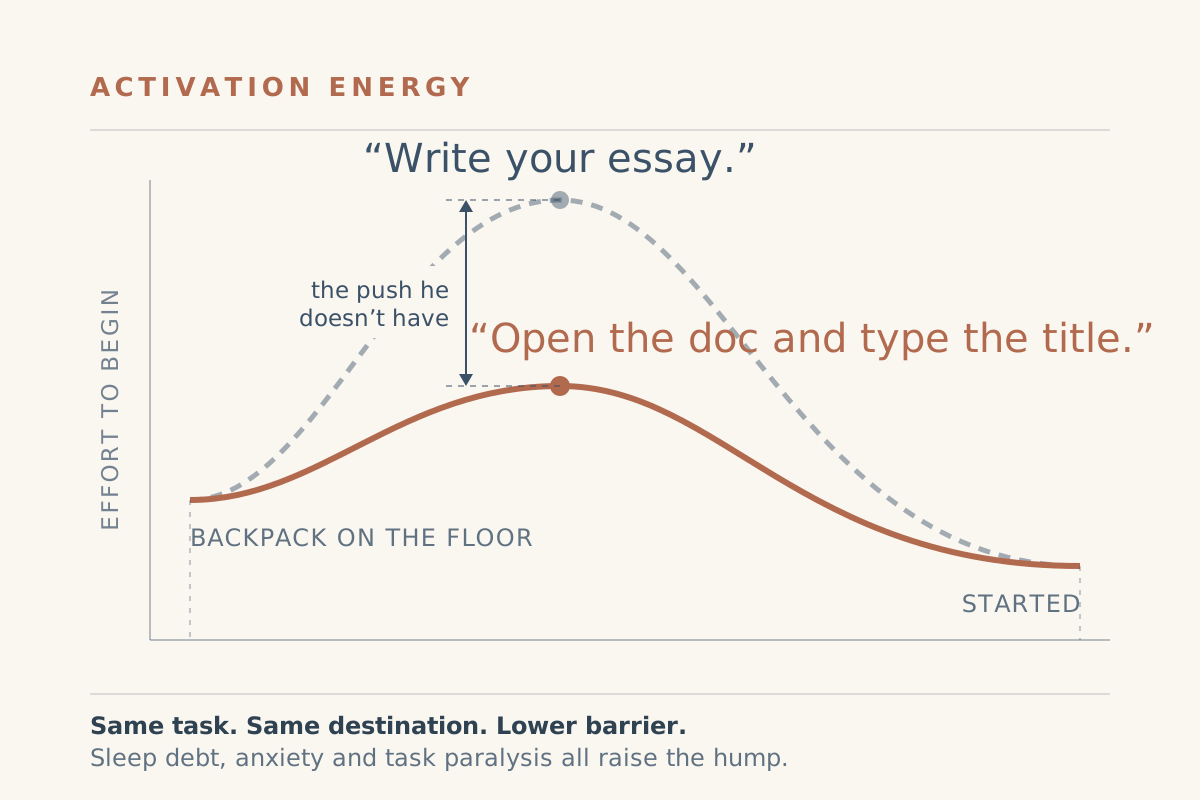
In chemistry, activation energy is the minimum push required to get a reaction going. Some reactions need more than others. Teenagers need more than you do, and lack of sleep, anxiety, and task paralysis all raise the number.
So what’s happening on that bed isn’t a motivation problem. It’s a loop: the task creates anxiety, the phone kills the anxiety instantly, and the relief teaches him to escape faster next time. Every doom scroll is a successful escape from a bad feeling, and successful escapes get repeated.
Do this:
-
Shrink the first step until it’s almost insulting.
Don’t tell him to “write your essay.” Rather, “open the
doc up at least and type the title.” The goal isn’t productivity,
it’s getting started.
- Set a ten-minute timer and let him quit when it rings. They may try to actually keep going, in which case let them. But if they want to stop, let them. The deal has to be real, or it stops working the second time.
- Make it if-then. “After I put my plate in the sink, I sit at the table and open my binder.” Specific if-then plans are one of the more reliable findings in behavior change, because the decision gets made before the hard moment arrives.6
-
Build a cue and reward the finish. Funny enough, this is exactly
how you’d train a dog. Which you may find you prefer.
- One parent I talked with made the kitchen light the cue: light on means we’re working. It worked so well that she once flipped it on while showing a client, forgot about it, and came home late to find her son still at the table thinking please, turn it off.
- Sit near him and do your own work. Say nothing about his. Costs you twenty minutes, works far better than it should. This is known as body doubling — very powerful stuff.
-
Write the physical action, not the subject. “Math”
is a category. “Problems 4–11, page 212” is something a person
can finish.
- The site goblin.tools does this for free — its Magic ToDo chops a vague task into as many small ones as you want. One of the rare moments AI genuinely helps them. (I have a lot to say about AI, so stay tuned.)
The homework gets less scary when it looks like an ice cube instead of an iceberg.
3. Deliberate practice
“How can you do this bad on a test? Did you even study?”
“I studied for three hours!”
He really did.
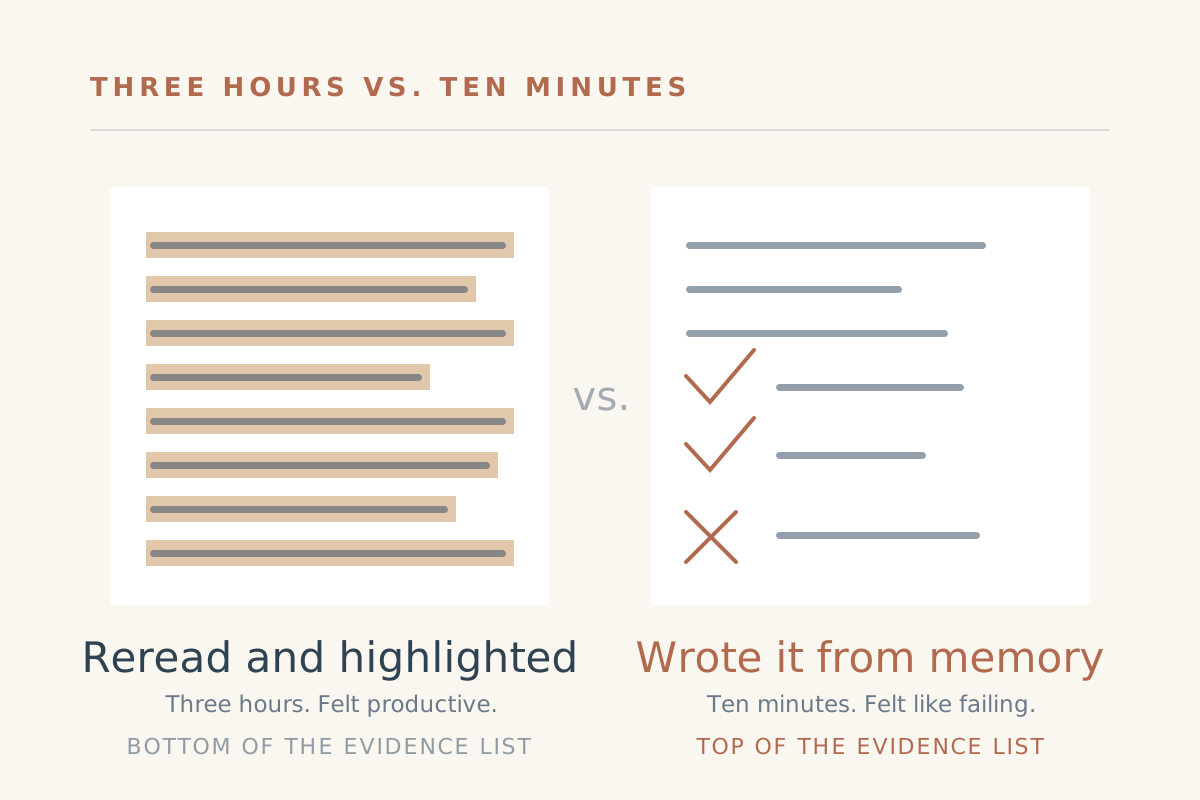
The night before the test, he read the packet his teacher gave him — not once, but twice. Then a third time, wielding a powerful memory tool: the highlighter. He highlighted everything that seemed important, and all of it seemed important. Then he tore a blank page out of his notebook and rewrote all his notes, until everything felt familiar.
Three hours of real effort, yet a C.
“Study more.”
Time isn’t the driver. In 2013 a team led by John Dunlosky ranked ten common study techniques by how much evidence supported them. Practice testing and spreading study came out on top for every age and ability level. Highlighting and rereading landed at the bottom.7
Your kid is doing three hours of the bottom of the list, and it feels productive the entire time. That’s the cruel part: the strategies that feel best work worst. Rereading feels smooth. Highlighting feels organized. Kids optimize for the feeling, because nobody ever told them the feeling is backwards.
Four things are worth his time:
- Spacing. Same three hours, split across three days. Researchers have documented this since the 1880s8 — one review pulled together 839 separate assessments of it9 — and it holds up in real classrooms, not just labs.10 It seems like magic that just spreading the same total time changes anything.
- Retrieval. Close the book, write what you remember, then check. Ten minutes of this can be enough for him to hate it, because it feels like failing — which is the point. That mental pain is cognitive load, and cognitive load is the place where durable learning can really happen. Rereading is specifically designed to avoid that feeling. I always say it’s like exercising — it hurts, but you can’t grow without it.
- Deep processing. One test: could they have done this without understanding it? They could highlight without understanding anything they highlighted, but they can’t explain, compare, or predict without understanding. That’s what deep processing looks like. At its core, it’s just being an involved participant in your learning.
- Self correcting. Familiarity is a liar. The third time through the packet everything looks recognizable, and recognizable feels like known. But you don’t get tested on recognizing (at higher levels). Recognizing an answer and producing one are two different abilities, and only one of them is on the test.
Do this — all questions, no instructions:
- “When are you studying for this?” Asked the day it’s assigned. Spacing is a scheduling problem, not a studying problem. If timing is tight, something is always better than nothing, so remind them that even 5 minutes is okay.
- “Teach it to me.” Allow him to be genuinely bad at his subject and ask “wait, why?” a lot. Failure is the point, and it’s a good thing (more on this in the next section).
- “What did you do well? What could you do better?” Every time. That’s the whole self-correction loop. My wife does this at work and I do this with my students.
If studying feels comfortable, it isn’t studying.
4. Self efficacy
“I’m just bad at math.”
Like it’s a law of nature. He stops trying before the unit starts, and when you push, he shrugs and tells you he doesn’t care.
Don’t believe that part. Nobody builds armor around something that doesn’t hurt.
“You’re so smart, you just need to apply yourself.”
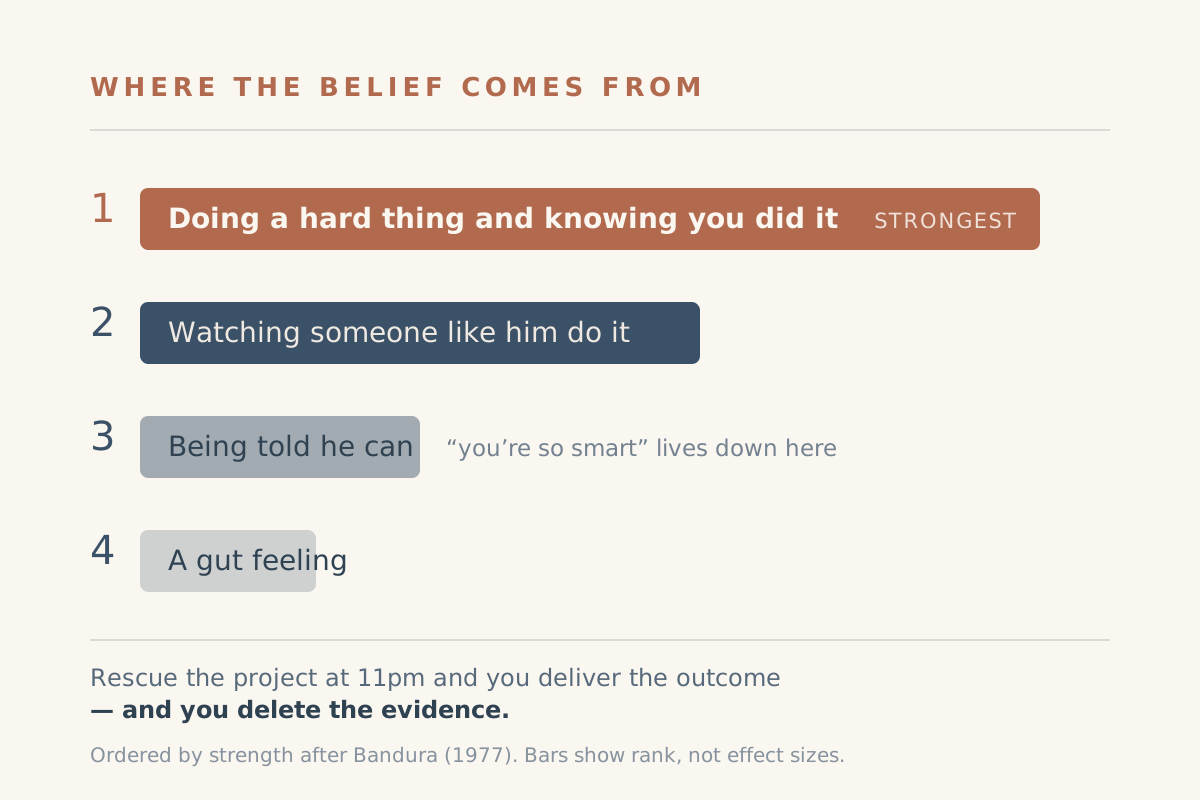
Self efficacy is the belief that when I do things, things happen. Albert Bandura found it predicts persistence better than actual ability does, and he ranked where it comes from. Strongest source: doing a hard thing and knowing you were the one who did it. No pep talk ever comes close.11
So you cannot talk him into it. If you could, he’d already believe it.
And “you’re so smart” is worse than neutral, because it hands him something he can lose. Once smart is who they are, every hard problem becomes a threat to it, and quitting starts to look like the safe move. They aren’t giving up on math. They’re protecting the last good thing they think they are.
Then there’s the trap that catches the most loving parents, and I’m going to be direct about it. Every time you rescue the project at 11pm — you find the rubric, you fix the formatting, you email the teacher at six in the morning — you deliver the outcome and you delete the evidence. They passed! And what they learned was that things worked out when you stepped in.
That’s self efficacy. It just isn’t theirs.
I’m not telling you to stop caring. I’m telling you to let go of control and let them fail.
Do this:
- Hand over one thing completely — including the right to fail.
- Praise the mechanism, not the trait. Not “you’re smart.” Try “you broke that into three parts instead of staring at the whole thing.” One is a verdict they have to defend. The other is a skill they can apply to everything else.
5. Failure as data
The report card is on the counter. He’s already upstairs with the door shut, and you’re standing in the kitchen deciding whether to bring it up now or at dinner.
Either way, here’s what happens: everyone feels terrible, and nobody learns one thing from the test.
“Failure is not fatal.”
It isn’t a belief you install with a speech. It’s a procedure you run together until they run it alone.
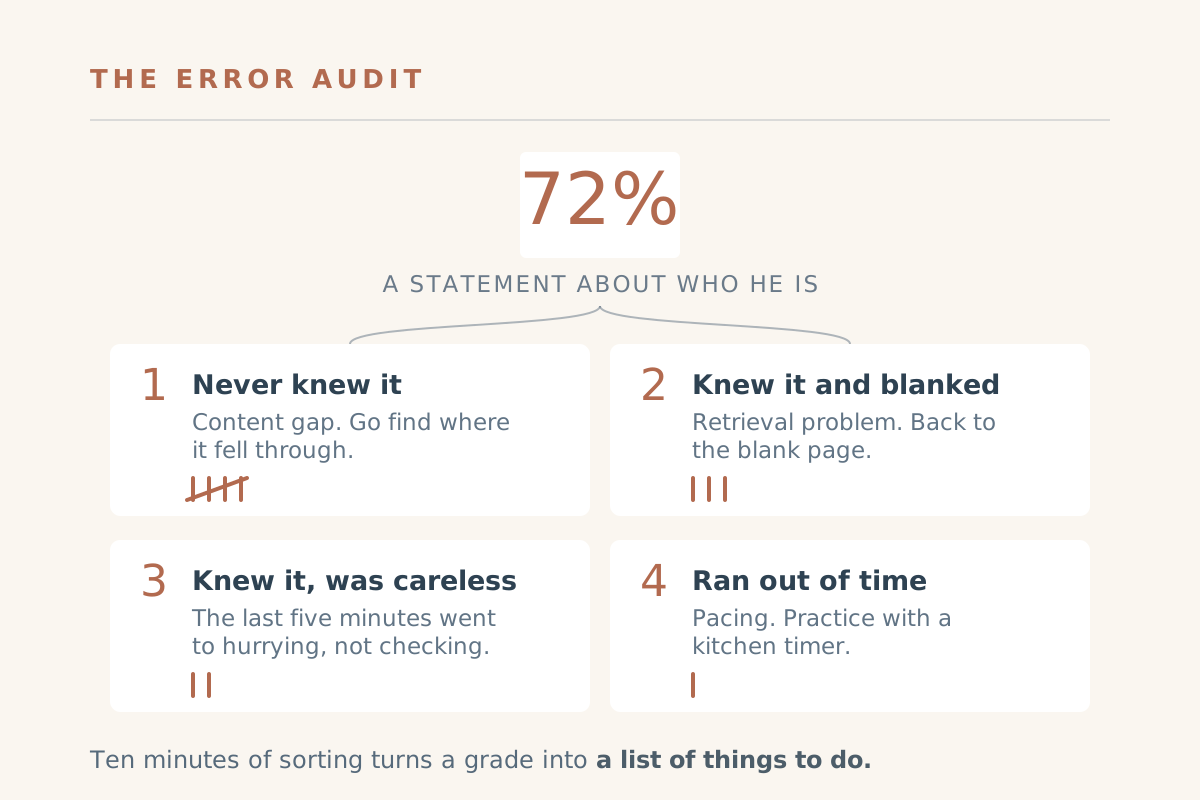
The error audit
Get the actual test from the teacher. Sort every wrong answer into four piles:
- 1. Never knew it — content gap. Go find where it fell through.
- 2. Knew it and blanked — retrieval problem. Back to the blank page.
- 3. Knew it and was careless — the last five minutes were spent hurrying instead of checking.
- 4. Ran out of time — pacing. Practice with a kitchen timer.
Ten minutes of this beats an hour of disappointment. And it does something bigger than the test: it takes a grade, which is a statement about who they are, and turns it into a list, which is a set of things to do.
You’re not trying to raise a kid who never fails. You’re raising a kid who knows what to do next by himself. One who doesn’t quit.
Where to start
You don’t have to teach all five things. Teach one this month — and allow yourself to blunder, it’s data after all.
Start with sleep, because it’s the one that makes the other four easier, and it’s the only one you can start tonight — with a charger and a kitchen counter.
You Don’t Have to Keep Doing It Alone
If you’ve been doing this at 11pm, for a class you never took, for a kid who can’t tell you what’s wrong because they don’t know either — that’s what the Insight Session is for. A free conversation about which of the five is actually in the way.
Rather keep reading? What executive function coaching actually involves — or whether your child needs a tutor at all.
One note before the sources
Every kid is different, and what works for one won’t work for another. These are the strategies I’ve seen work most reliably with school-aged kids, including many with ADHD. If your child has a diagnosis or an IEP, bring these to the people who know him.
References
- Penn Medicine. “Penn Medicine Experts Explain the Science Behind Later School Start Times.” August 2026. pennmedicine.org ↩
- American Academy of Sleep Medicine sleep duration recommendation for teens ages 13–18, as cited in Penn Medicine, above. ↩
- American Academy of Pediatrics. “School Start Times for Adolescents.” Pediatrics, 2014. ↩
- Beebe, D. W. “Cognitive, Behavioral, and Functional Consequences of Inadequate Sleep in Children and Adolescents.” Pediatric Clinics of North America, 58(3), 649–665, 2011. pubmed.ncbi.nlm.nih.gov ↩
- Arain, M., Haque, M., Johal, L., Mathur, P., Nel, W., Rais, A., Sandhu, R., & Sharma, S. “Maturation of the Adolescent Brain.” Neuropsychiatric Disease and Treatment, 9, 449–461, 2013. pmc.ncbi.nlm.nih.gov ↩
- Gollwitzer, P. M. “Implementation Intentions: Strong Effects of Simple Plans.” American Psychologist, 1999. ↩
- Dunlosky, J., Rawson, K. A., Marsh, E. J., Nathan, M. J., & Willingham, D. T. “Improving Students’ Learning With Effective Learning Techniques: Promising Directions From Cognitive and Educational Psychology.” Psychological Science in the Public Interest, 14(1), 4–58, 2013. journals.sagepub.com ↩
- Hermann Ebbinghaus, Über das Gedächtnis, 1885. ↩
- Cepeda, N. J., Pashler, H., Vul, E., Wixted, J. T., & Rohrer, D. “Distributed Practice in Verbal Recall Tasks: A Review and Quantitative Synthesis.” Psychological Bulletin, 2006. (839 assessments across 317 experiments in 184 articles.) ↩
- Mawson, R. D., & Kang, S. H. K. “The Distributed Practice Effect on Classroom Learning: A Meta-Analytic Review of Applied Research.” Behavioral Sciences, 2025. (d = 0.54 across 31 effect sizes, N > 3000.) ncbi.nlm.nih.gov ↩
- Bandura, A. “Self-Efficacy: Toward a Unifying Theory of Behavioral Change.” Psychological Review, 1977. ↩